


SPOTLIGHT ON - With a pinch of salt please - the history of 'salts'
Silver antiques are well known for their beauty and collectability, and antique salt and pepper cellars are no exception. Ornately designed and sometimes paired in what is called a ‘cruet stand,’ these unique & magnificent pieces of hollowware can transform the setting of any dinning table.Salt has been an important part of the dining tradition for hundreds of years. During the Middle Ages, the rarity of salt meant it was not only used for its taste, but also considered as a status symbol. Royalty and better households offered their guests small round shaped individual salt cellars (or salts, as they were then known) and pepper casters at the dining table. The best examples of these objects were made out of sterling silver.


Later in the century, footed cellars with pierced sides were popular—a glass dish that fit within the cellar kept the salt from spilling out. Today many of these pieces of tableware are passed or sold down through generations and have acquired antique value.
The varieties of antique cellars found today are generally from the 19th century onward. The following list outlines some of the typical features of antique solid silver salt and pepper cellars.
1. Silver Designs - Cellars can be given individual designs and ornate patterns using various methods including repoussé (also called embossing)
2. Engraving - Solid silver is often engraved. Most pieces will carry a quality number, such as 925 for sterling silver, and also a mark that identifies the manufacturer. Other engraving may also be found on personalized cellars, such as the monogramming of a previous owner’s initials.
3.Cut Glass - If present on a salt or pepper cellar, the glass body can be flat or cut to have patterns and textures such as Grecian designs. The glass may also be stained with color on some cellars.
4. Handles - Though less common, some antique salt and pepper cellars will have their silverwork extended to incorporate a small handle for ease of lifting.
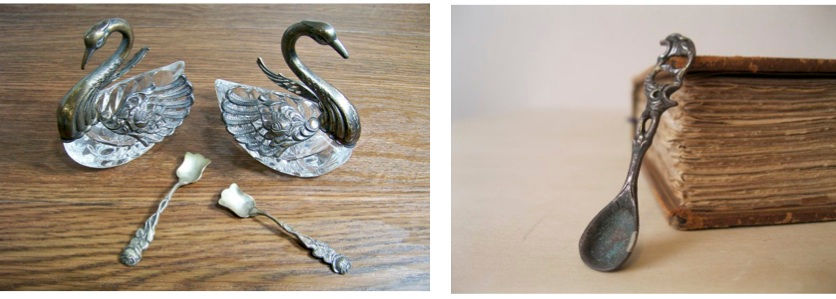
The salt cellar is used differently in formal and informal dining. Herein bellow we address its etiquette usages:
At formal affairs, salt is always applied from a salt cellar; a method that provides controlled use of salt. A small spoon is presented in the salt cellar and used to sprinkle salt over food.
Salt cellars are not usually used for informal meals, but when it is, salt it is sprinkled over food with a salt spoon. Or, a small mound of salt is placed on the bread-and-butter plate or dinner plate
When a salt spoon is not provided with the salt cellar, a pinch of salt is taken with fingers and sprinkled over food. Food is never dipped into a salt cellar.

And now comes the fun part – these are fun & noteworthy facts you might have not known about before:
1. Because salt bears a close resemblance to arsenic, at medieval meals salt was tested by an assayer for poison; after the meal it was locked in the cellar for storage against theft - hence the term salt cellar.
2. During the 18th century, guests did not typically “pass the salt.” Instead, salts (salt cellars) were sold in individual sets, so that each guest might have had his or her own, which was not a bad idea since salt was commonly applied to food with the fingers back then. And since more people used salt than pepper (and most people are right-handed), the salt cellar was placed to the right of the dinner plate, in a position closer to the right hand.

We shall end this feature article by providing you with a few simple methods for caring for your antique salt and pepper cellars, ensuring that they retain their luster for years to come.
Always empty the cellar of its contents before storage. Salt is a corrosive agent and keeping salt in your silver cellars for long periods of time, will damage the silver layer.
Since these cellars are usually small in size, when not in use, store them in a dry, zip-lock bag to prevent moisture and air from tarnishing the silver.
Occasionally wash and polish the silver using a small amount of silver polish, ensuring to buff and rinse it away after polishing, leaving the piece dry.
If a cellar has a glass body, ensure that it is stored in a safe environment that prohibits it from being chipped.
It is best not to put them in any dishwasher.
We shall admit that at Patine we have a bit of an obsession and weakness for these lovely objects and, which is indeed reflected through our large & uninterrupted inventory. To own similar pieces, please do kindly contact us for a private viewing.


Comments